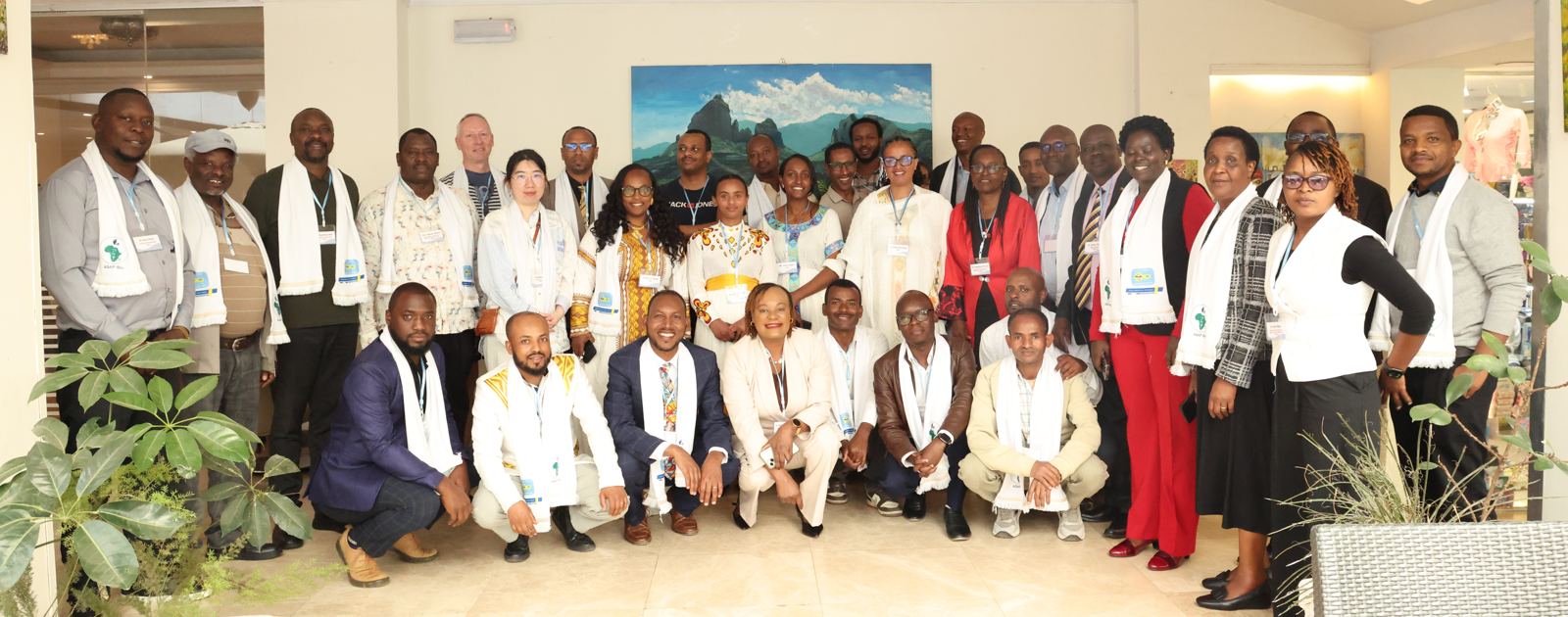
From 26 to 28 October 2026, 40 academic staff from the five ASAP-Bio partner universities met in Addis Ababa for a three-day workshop on strengthening animal science education through active pedagogy, digital innovation and peer learning. The workshop was hosted by Debre Berhan University.
Animal science lecturers bring deep subject expertise. The partners' education faculties bring expertise in how students learn. The workshop put the two in the same room: domain experts and pedagogy specialists from Ethiopia, Kenya, Uganda and Denmark worked side by side, and the sessions were designed and led jointly by colleagues from all five universities.
Day 1: what and why we teach
The workshop opened with institutional snapshots from each partner, describing how animal science is taught today, what works, and where the difficulties lie. Debre Berhan University, the University of Nairobi, Muni University and JKUAT presented in the room, and Aarhus University joined online with a presentation on animal science education at its Department of Animal and Veterinary Sciences.
Pedagogy specialists from Debre Berhan, Muni, Nairobi and JKUAT then described how their education faculties support domain departments, followed by an online input from the Centre for Educational Development at Aarhus University.
In mixed-institution groups, participants clustered and prioritised the teaching challenges they share, and then turned to the foundations of the workshop: competences, measurable learning outcomes, constructive alignment and curricula that are relevant to local livestock systems. Each group mapped an international competence in animal science onto local practice, and each participant chose one of their own courses to redesign over the three days, the Course Redesign Challenge.
Day 2: how we teach
The second day was about active and learner-centred teaching. After short inputs and live demonstrations of methods such as think-pair-share, jigsaw, case studies and problem-based learning, groups designed and rehearsed a 15-minute learning activity for a competence from their own courses. Each group then delivered its activity to the rest of the room, with the other participants taking part as students and giving structured feedback.
In the afternoon the focus moved to blended and digital teaching. Participants explored the ASAP-Bio Knowledge Hub, built their own teaching web pages on GitHub, and used computer simulation to explore how breeding decisions play out over generations, as a tool for teaching animal breeding.
Day 3: how we know learning happened
The final day covered assessment and feedback. Participants designed authentic field and laboratory assessments with analytic rubrics and reviewed each other's work across institutions. In microteaching groups, each participant taught a short lesson and received structured feedback. The workshop closed with an action plan from each institution, with priority actions, responsibilities and timelines, and with focal persons who will keep the work going.
Led by the partnership
The sessions were convened and facilitated by colleagues across the partnership, among them:
- Bethel Geremew and Dereje Andargie, Debre Berhan University
- Catherine Kunyanga and Mercy Mugambi, University of Nairobi
- Polycarp Omara, Muni University
- Perpetual Ndungu, Sepha Mabeya and Johnson Kinyua, JKUAT
- Tina Bering Keiding, Centre for Educational Development, Aarhus University
- Maria Eskildsen, Department of Animal and Veterinary Sciences, Aarhus University
- Laura Skrubbeltrang Hansen, Huiming Liu and Grum Gebreyesus, Center for Quantitative Genetics and Genomics, Aarhus University
What comes next
Participants continue to redesign their courses with the support of coaching pairs, and the institutional action plans will be followed up through the partners' focal persons. Teaching materials developed through ASAP-Bio are shared openly on the Knowledge Hub.
ASAP-Bio is an African–Danish university partnership in integrated sustainable animal production systems, funded by the Ministry of Foreign Affairs of Denmark and managed by Danida Fellowship Centre.